

Global 1,3-Dibromoadamantane Market to Reach USD 55.22 Million by 2036, Driven by Semiconductor & Pharma Demand
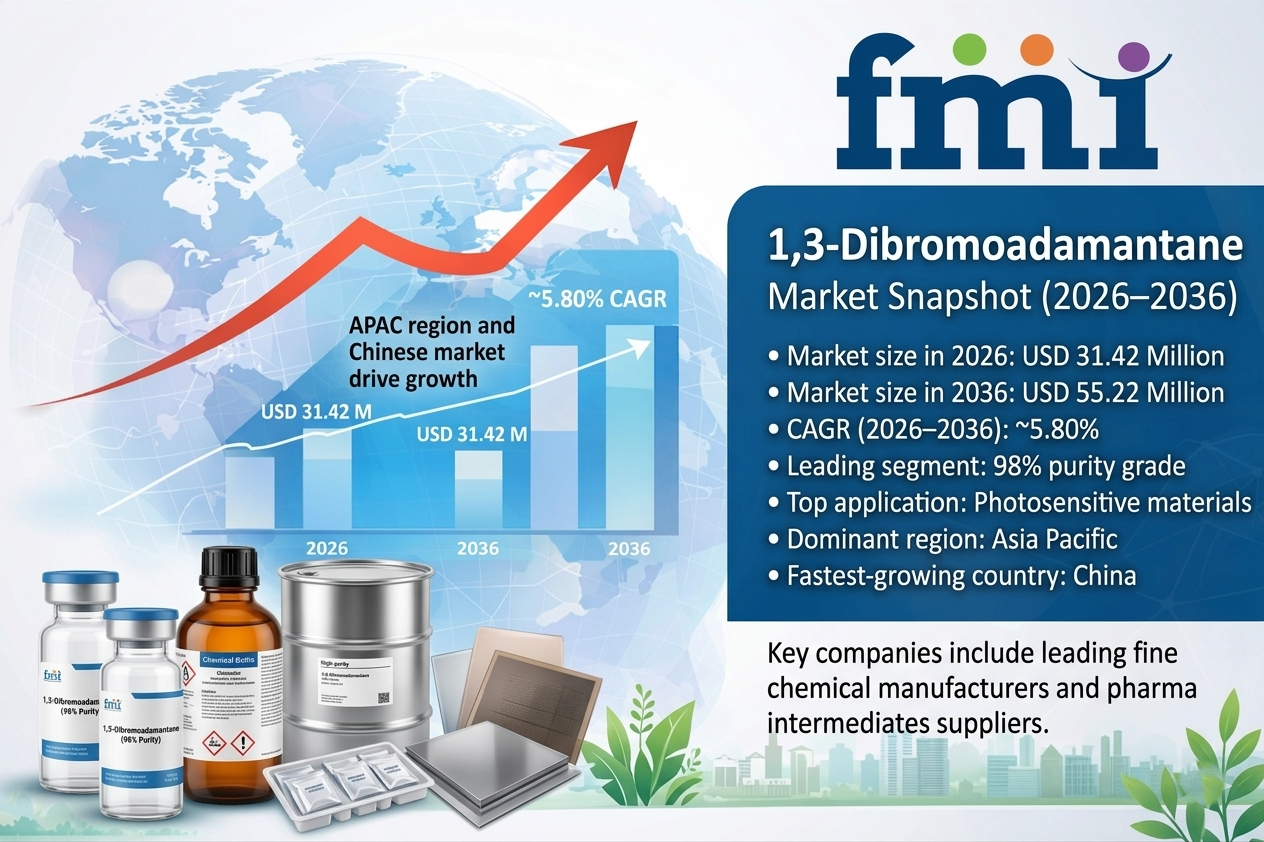
Rising EUV lithography adoption and pharmaceutical synthesis demand accelerate growth in the 1,3-dibromoadamantane market through 2036.
NEWARK, DE, UNITED STATES, March 30, 2026 /EINPresswire.com/ -- The global 1,3-dibromoadamantane market is valued at USD 31.42 million in 2026 and is projected to reach USD 55.22 million by 2036, expanding at a CAGR of 5.80% during the forecast period. Growth is primarily driven by increasing adoption of EUV lithography in semiconductor manufacturing and rising demand for advanced pharmaceutical intermediates.
As industries shift toward precision manufacturing and high-performance materials, 1,3-dibromoadamantane has emerged as a critical specialty chemical. Its role as a structural precursor in photoresist chemistry and pharmaceutical synthesis positions it as a strategic compound across next-generation technologies.
1,3-Dibromoadamantane Market Snapshot (2026–2036)
• Market size in 2026: USD 31.42 million
• Market size in 2036: USD 55.22 million
• CAGR (2026–2036): ~5.80%
• Leading segment: 98% purity grade
• Top application: Photosensitive materials
• Dominant region: Asia Pacific
• Fastest-growing country: China
• Key companies: Global fine chemical manufacturers and pharma intermediates suppliers
Market Momentum
The market begins at USD 31.42 million in 2026, supported by growing demand from semiconductor photoresist manufacturing and pharmaceutical synthesis pipelines. Between 2027 and 2030, advancements in EUV lithography and increasing investments in fine chemical production drive consistent demand growth.
Entering 2032 and beyond, expansion of pharmaceutical innovation programs and rising adoption of high-purity intermediates strengthen market dynamics. By 2036, the market reaches USD 55.22 million, driven by increasing integration across semiconductor, pharmaceutical, and specialty chemical industries.
Request For Sample Report | Customize Report | Purchase Full Report
https://www.futuremarketinsights.com/reports/sample/rep-gb-26834
Why the Market is Growing
The 1,3-dibromoadamantane market is expanding as industries prioritize high-performance intermediates that offer superior chemical stability, purity, and synthesis flexibility. In semiconductor manufacturing, the compound is widely used in photoacid generators and polymer additives required for EUV lithography at sub-7nm nodes.
In pharmaceutical applications, adamantane-based scaffolds are increasingly utilized in antiviral, neurological, and oncology drug development. This has elevated the demand for 1,3-dibromoadamantane as a versatile intermediate for complex molecular synthesis.
Additionally, advancements in bromination processes—particularly in China—are reducing production costs by up to 30%, enabling large-scale supply to both semiconductor and pharmaceutical sectors. Sustainability trends and precision manufacturing requirements are further supporting adoption.
Segment Spotlight
Segment Spotlight
1. Purity Grade: 98% Purity Leads Market Share
The 98% purity segment accounts for approximately 62.4% of the market, driven by its cost-effectiveness and widespread application across industrial chemical synthesis. It provides reliable performance for large-scale manufacturing while maintaining affordability.
2. Application: Photosensitive Materials Dominate
Photosensitive materials hold nearly 45.2% share, reflecting the compound’s essential role in semiconductor photoresist chemistry. Its stability and UV resistance make it indispensable in advanced imaging and lithography technologies.
3. End Use: Pharmaceutical Synthesis Expands Rapidly
Pharmaceutical applications are witnessing strong growth due to increasing demand for high-purity intermediates in advanced drug discovery and synthesis programs.
Drivers, Opportunities, Trends, Challenges
• Drivers: Rising semiconductor manufacturing, pharmaceutical innovation, demand for high-purity intermediates
• Opportunities: Advanced synthesis technologies, AI-driven chemical design, eco-friendly bromination processes
• Trends: Shift toward EUV lithography, high-purity chemical adoption, integration of digital chemistry platforms
• Challenges: High production costs, complex synthesis processes, competition from alternative intermediates
Country Growth Outlook (2026–2036)
China leads the market with a CAGR of 7.8%, driven by strong pharmaceutical manufacturing and expanding fine chemical production capacity. India follows at 7.3%, supported by rapid growth in pharmaceutical and chemical industries.
Germany records 6.7% growth, emphasizing advanced chemical technologies and high-purity synthesis. Brazil (6.1%) and the USA (5.5%) show steady expansion due to increasing investments in specialty chemicals and pharmaceutical innovation. The UK (4.9%) and Japan (4.4%) maintain stable growth driven by advanced manufacturing capabilities and quality-focused production.
Competitive Landscape
The market features a mix of specialized chemical manufacturers and pharmaceutical intermediate suppliers competing on innovation, purity, and production efficiency. Companies are investing in advanced synthesis technologies, purification systems, and application-specific product development.
Key players such as Matrix Fine Chemicals GmbH, Anstar New Material Technology, and FUJIFILM Wako Chemical Corporation are focusing on enhancing chemical purity, optimizing synthesis processes, and expanding global distribution networks.
Strategic initiatives include capacity expansion, partnerships with pharmaceutical companies, and adoption of digital chemistry platforms to improve product performance and reduce costs. Sustainability and regulatory compliance are also emerging as key competitive factors.
Frequently Asked Questions (FAQ)
What is the global 1,3-dibromoadamantane market size?
The market is valued at approximately USD 31.42 million in 2026 and is projected to reach USD 55.22 million by 2036.
At what rate is the market expected to grow?
The market is forecast to expand at a CAGR of about 5.80% from 2026 to 2036.
What is 1,3-dibromoadamantane?
It is a dihalogenated adamantane compound used as a building block in semiconductor photoresist chemistry, pharmaceutical synthesis, and specialty chemical manufacturing.
Why is this market growing?
Growth is driven by rising semiconductor demand, pharmaceutical innovation, and increasing need for high-purity chemical intermediates.
Explore More Related Studies Published by FMI Research:
Bulk Molding Compounds Market
https://www.futuremarketinsights.com/reports/bulk-molding-compounds-market
High Temperature Grease Market
https://www.futuremarketinsights.com/reports/high-temperature-grease-market
Emulsion Polymers Market
https://www.futuremarketinsights.com/reports/emulsion-polymers-market
About Future Market Insights (FMI)
Future Market Insights, Inc. (FMI) is an ESOMAR-certified, ISO 9001:2015 market research and consulting organization, trusted by Fortune 500 companies and global enterprises. With a strong global presence across the U.S., UK, India, and the Middle East, FMI delivers actionable insights across 30+ industries and over 1200 markets worldwide.
Why Choose FMI:
https://www.futuremarketinsights.com/why-fmi
Sudip Saha
Future Market Insights Inc.
+1 347-918-3531
rahul.singh@futuremarketinsights.com
Legal Disclaimer:
EIN Presswire provides this news content "as is" without warranty of any kind. We do not accept any responsibility or liability for the accuracy, content, images, videos, licenses, completeness, legality, or reliability of the information contained in this article. If you have any complaints or copyright issues related to this article, kindly contact the author above.
